
Ever read The Dot by Peter H. Reynolds? It’s about Vashti, a little girl who insists she can’t draw – only to realise that the single dot she makes can give rise to hundreds more dots. And it’s an idea that author Loren Lachman loves.
It’s an idea that Loren Lachman, author of Make Your Brain POP: Help Your Child Master a Mindset of Power, Optimism and Perseverance loves. “It shows kids that starting small – literally with one dot – is enough. It celebrates creativity, resilience, and the power of believing in yourself (with a little nudge from others), even when you feel you have no talent or when things seem impossible at first,” she says. So, here’s the big question: What if you could wire this possibility-thinking as their everyday default setting?
Loren has been working for years to wire these traits into her brain – in fact, ever since she became a mom for the first time eight years ago. Her belief (and the message that has grown out of it) is clear. Everyone has potential. It’s how we view effort, challenges, mistakes, and failure that determines whether that potential becomes reality.
“I remember holding my newborn in my arms and realising that he was completely dependent on me for his survival. Although I knew that meant looking after his physical needs, I understood something deeper … the mindset I gave him would shape his life long after I stopped feeding him,” Loren reflects.
Looking back, it’s clear Loren was always heading here. The concept of mindset captivated her as a teenager. She would often use the principles expounded by authors like John Kehoe (Mind Power) and Steven Covey (The Seven Habits of Highly Effective People) to reframe the way she looked at a situation, and this helped her realise that the problem is seldom the situation – it’s how you think about it. “That ability to shift perspective?” she reflects. “That became my life’s work. I just didn’t know it yet.”
Interestingly, though, rather than settling into a career as a therapist, Loren chose to focus on marketing after school. “Then again, the discipline definitely involves an element of psychology. You have to consider what drives people to make their purchasing decisions. It’s all about understanding their thinking.”
And understanding how the brain works – which is the foundation of Loren’s POP (power, optimism and perseverance) theory. She explains that during her pregnancy, she was reading about foetal development when she discovered that by the third trimester, a foetus can recognise your voice and even remember your words. This sparked an awareness of just how important your words, and the language you use when you speak to yourself and to others, can be.
“The book focuses on POP because I truly believe that these are the pillars of human potential. When they come together and you are able to use them effectively, you develop a mindset that will serve you for life,” Loren says. In a world that’s riddled with uncertainty, that hurls unprecedented obstacles at us and which is ever more difficult to navigate, the value of such a mindset cannot be overstated.
As Loren points out, it’s the difference between believing that you can’t do something, and that you can’t do it – yet. “I believe that life is a process of constant growth. To really tap into that, we first need to understand the functioning of the brain, then understand its neuroplasticity; the fact that it can change and adapt as we grow. That leads me to the concept of a fixed mindset – the belief that your capabilities are set in stone and won’t change throughout your life – versus a growth mindset, which acknowledges that with hard work, effort and perseverance, our capabilities can become unlimited.”
Of course, cultivating that growth mindset is far from easy, especially since we’re seldom aware of the stories we tell ourselves, or how they place a ceiling on what we think we can do. More specifically, we don’t think about how we apply this in our thinking, and how it shapes our children’s ways of thinking about themselves. For example, if your child achieves full marks on a test, you’re likely to say something like, “You’re so smart! This is easy for you.” You might think you’re building confidence. But your child’s brain just learned: I succeed because I’m smart, not because I work hard.
When that same child faces a difficult test months later and refuses to study because “if I’m smart, I shouldn’t have to try this hard,” they’re not being lazy – they’re just protecting the identity their parent built. The result, according to Loren, is a type of learned helplessness which holds our kids back from being all they can be.
So, how do we break the cycle? “It all starts with being aware of your thinking. Often, these patterns are subconscious – we have a negativity bias and repeat the same stories to ourselves over and over again. So, we need to break that cycle by becoming aware, pausing and then reframing. And remind yourself that your words are building your child’s brain. The question becomes, are you building possibility, or limitation?” Loren advises.
Since publishing her book, Loren has developed comprehensive POP training workshops for parents, teachers and corporate teams, equipping them with the neuroscience-backed tools to build Power, Optimism, and Perseverance in themselves first, essential in a culture where endless social comparison, fear of failure and performance pressure threaten to wire an entire generation for anxiety rather than resilience.
Next, she’s planning to introduce a similar course for kids themselves, so that the power and potential of POP move beyond the page to create a generation that grows up not just believing in their potential, but understanding exactly how to unlock it.
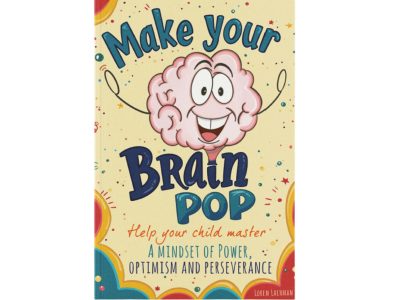
Make Your Brain POP, R260 from Exclusive Books and Readers Warehouse Nationwide.
The POP toolkit
• Power: This is all about the idea that we have agency, that we can influence outcomes, that our ideas matter and we all have something valuable to contribute. When we and our children understand this, says Loren, we can use that knowledge to make better choices.
• Optimism isn’t just a form of toxic positivity and telling ourselves that everything is going to be ok (especially when there is no proof that it will). It’s learning how to develop ‘learned optimism’ through the lens of possibility thinking.
• Perseverance requires us to view effort as the path to mastery, to see mistakes as stepping stones, and persistence as the real superpower. Frustration, failure, trying again – that’s how we grow. The moment you want to give up is often the moment your brain is growing most. But it’s more than just “not giving up”, it’s understanding that struggle is the mechanism of growth.

Details: thepopmindset.com, follow @ThePopmindset on social media
Location: Home Suites Hotel Rosebank, www.homesuitehotels.com
Article by Lisa Witepski. Photo by Megan Brett.