

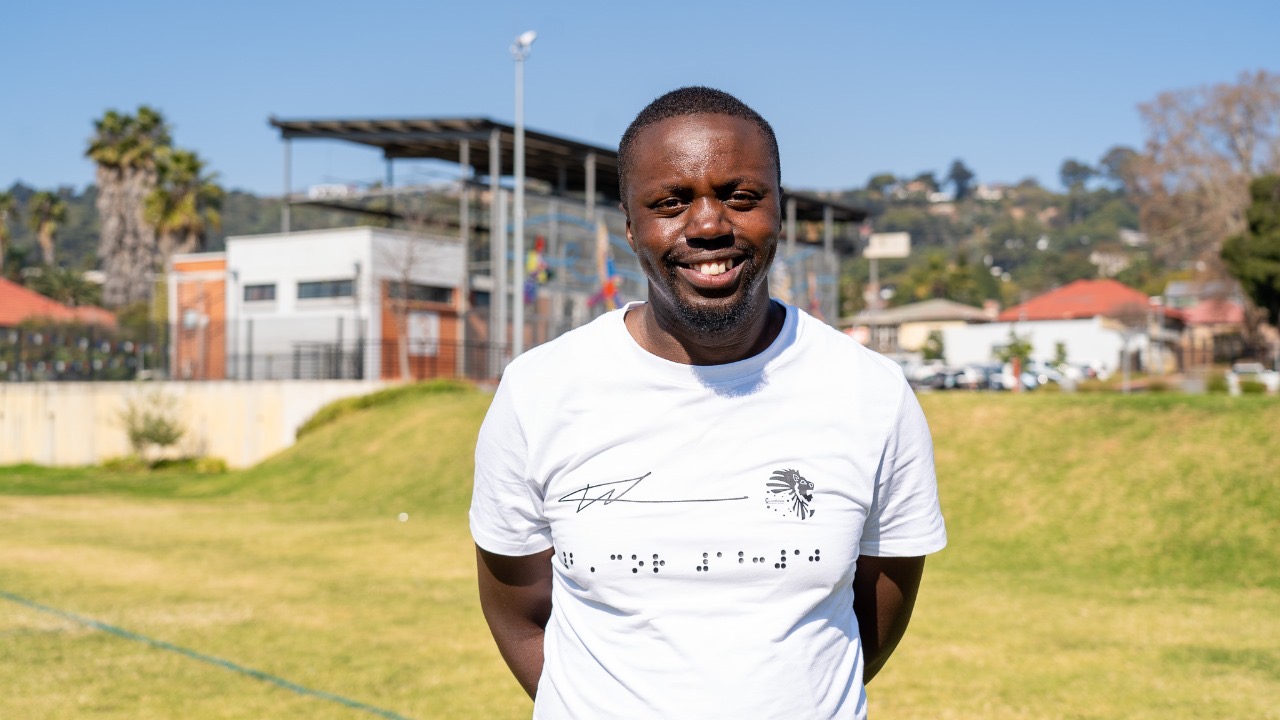
In the absence of many fathers, Mlungisi Jack Msibi stepped in to fill the gap. Through Corinthians Africa, he has become a steady presence in the lives of thousands of children, offering guidance, love and leadership where it is needed most.
Mlungisi Jack Msibi’s (33) story begins long before the fields, the trophies, and the recognition.
His name itself carries meaning. ‘Mlungisi means the one who establishes order, the one who fixes,’ he explains. It is a definition that would later shape not only his life, but the lives of thousands of young people.
Life’s unexpected turns
Born in Johannesburg CBD and raised by his mother, Wendy Msibi, he grew up in a single-parent household alongside his younger brother. His childhood, by his own admission, was far from perfect.

‘Growing up I was quite naughty,’ he says, recalling days of mischief. Yet even then, there were signs of something deeper. ‘I’ve always had a heart for people,’ he said, sharing how he often found himself in leadership roles without even trying. His early education took him through Parkview Senior and King Edward VII School, environments that helped shape his discipline and exposure.
But it was the move to South Hills in his late teens that would become the turning point in his life. South Hills offered a new beginning for the Msibi family. Moving from a flat into a house was exciting, a symbol of progress.
Yet the area itself told a more complex story. It was diverse, but deeply unequal. It was here that Jack became a youth leader at his church under the mentorship of Pastor Lionel Botha. He had plans, like many young people, to further his studies but life had other ideas.
Financial challenges forced him to drop out of university in his first year. ‘I became a statistic of unemployment,’ he says. What could have been a stopping point became, instead, the beginning of something far greater.
More than just a coach
The idea for Corinthians Africa did not come from a business plan or a strategic meeting. It came from the streets. Three boys, involved in drugs and out of school, approached Jack while he was playing a casual game with his younger brother.

They asked to join. ‘That was the start of Corinthians. Those young people are the ones who started it.’ The next day, more children arrived at his gate, calling him ‘Coach Jack’ – a name he had never claimed for himself.
‘I didn’t know anything about coaching,’ he admits. Still, he took them to a nearby park. ‘I opened up in prayer… and I found myself speaking and imparting to them,’ he recalls. ‘I found myself literally falling in love with these kids that I don’t even know.’
What began with a handful of boys quickly grew into a movement. For seven years, without formal registration or infrastructure, Corinthians Africa operated purely on passion and purpose.
‘It was not just about soccer. It was about seeing these young males become better.’ As the initiative grew, so did Jack’s role. He was no longer just a coach. He became something far more significant; he became a father figure.
‘That’s where the fatherhood aspect comes from. I’d become not only just a coach, I’d become a father to them,’ he says. In the community, this role became known as a whole-life coaching initiative, Ubabalo. It is designed to help coach Jack and other coaches to act as ‘father figures’ and use sports as a way to mentor participants. It is a form of fathering that goes beyond biology. The boys, many of whom were involved in harmful activities, began to change.
‘Whenever they saw me, they would hide whatever wrong they were doing because there was a father figure,’ he explains. His influence extended beyond physical training. He nurtured their emotional, spiritual and mental growth.
‘It was about their well-being and their livelihoods.’
Loss, pause and return
In 2018, tragedy struck when Jack lost his mother. The loss was devastating. ‘I stopped Corinthians. I said I am done with community work.’ But the absence of the programme quickly revealed its importance.
Without it, many young people drifted back into gangs, substance abuse and crime. Community leaders reached out, urging him to return.
‘They said, ‘Coach Jack, we want you to come back because your kids have joined gangs,’ he recalls. Reluctantly, he agreed and was offered a facility and this marked a new chapter for Corinthians Africa.
The fathers no one talks about While Jack is often celebrated, he is quick to acknowledge others, especially the unlikely contributors. He speaks fondly of men from a local tavern, KwaNgwenya, in South Hills, who supported the initiative in small but meaningful ways.
‘Those men exemplified fatherhood,’ he says. Despite their personal struggles, they gave what they could. ‘They would come and give us R10, R20; they were present for these kids that they never knew.’
For Jack, fatherhood is not about perfection. ‘Fatherhood is not what we do. Fatherhood is who we are,’ he explains. Today, Corinthians Africa is far more than a soccer initiative. It is a thriving ecosystem that reaches over 5 000 people monthly.
It has earned national recognition, including major awards for community impact and human rights work. Yet for Jack, the heart of the organisation remains unchanged.
‘It’s a safe hub,’ he says. ‘A place where people can discover who they are and what God has called them to be.’
The organisation now includes education programmes, a STEAM centre, and even a pioneering blind football league. ‘We’re doing what no one has done,’ he says. And despite not having biological children, Jack carries the title of ‘father’ with deep seriousness.
‘It’s a serious responsibility. I must become a template for society,’ he shares. He understands the influence he holds and the example he must set.
‘There’s a responsibility in my conduct, in my behaviour, in my ethics – not for me, but for the next person.’ Fatherhood, in his view, is about presence, guidance and consistency. While he mentors thousands, Jack is equally shaped by them. ‘Corinthians has taught me a lot about me,’ he says. ‘It’s taught me patience and it’s taught me how to love people.’
Perhaps most importantly, it has taught him self-worth. ‘It’s taught me that I’m more than enough,’ he shares. In a world that often measures value by status or success, the unconditional love of the children has been transformative.
‘They will love you regardless of what you are wearing, regardless of what car you are driving.’ At the core of Jack’s work is a response to a larger societal issue – fatherlessness.
‘We have a pandemic of fatherlessness,” he says. Many children lack both a biological father and a role model. ‘This absence often leads to identity struggles, risky behaviour and a search for belonging in unhealthy spaces. They are seeking community and a father figure,’ he explains.
His approach to mentorship is listening first. ‘Mentorship is listening before imparting. Your impartation must be contextual.’
Redefining fatherhood
The journey has not been without sacrifice. Jack has given up opportunities, including a high-paying job overseas. ‘It cost me, but I wouldn’t trade this for anything.’

He has lost relationships, faced misunderstandings, and endured personal challenges. Yet his commitment remains firm. ‘It will cost you to fulfill your purpose. It will cost you something to realise what God has called you to do.’
Jack’s vision for Corinthians Africa is ambitious. He hopes to expand it across all nine provinces in South Africa. More importantly, he wants to see new leaders rise. ‘My heart is to pass on the baton to the next generation,’ he says.
Additionally, for Jack, Father’s Day is both surprising and humbling. ‘I get more gifts on Father’s Day than on my birthday,’ he says with a smile. Though he sometimes feels conflicted, people often say to him ‘you’re not a father’, but the appreciation he receives affirms his impact.
‘It’s a very humbling day for me,’ he adds.
This Father’s Day, Jack offers a message to men everywhere: ‘It’s okay wherever you are but it’s not okay to stay there,’ he says
He believes fatherhood is accessible to all men, regardless of their past. It begins with the willingness to lead by example. In communities where many children are still searching for guidance, figures like coach Jack are proof that fatherhood is not defined by biology but by action, sacrifice and love.
Photos: THANDI SIBEKO. Text: DESNAY PETERSON


