Jenny Dean shares how indigenous planting can transform ordinary gardens into beautiful sanctuaries that provide food, shelter and habitat for birds, butterflies, insects and other wildlife.
In a world that seems to move faster every year, a garden can offer something increasingly precious: a place to slow down, breathe, reconnect with nature and step away from the noise of everyday life. For indigenous garden mentor, landscaper and nursery owner Jenny Dean, this is exactly what a garden should be.
With more than 30 years of experience gardening with South Africa’s indigenous plants, Jenny has built her work around the simple but powerful idea that our gardens can be beautiful spaces for people while also becoming vital habitats for the creatures that share our environment.
“Life is so fast and busy for all of us,” says Jenny. “Our gardens can be a haven, a retreat from the world, a place where we can come back to peace.”
But Jenny’s vision extends beyond creating a peaceful outdoor space. As development continues to reduce natural habitat, gardens can play an important role in providing food and shelter for birds, insects, bees and butterflies.
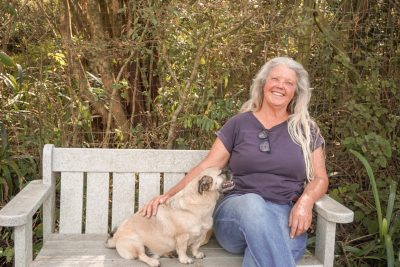
“We can make a difference in our gardens by planting local South African plants and replacing, in a small way, some of our lost habitat.”
One of the joys of gardening for wildlife is discovering that every plant can have a role.
Take the indigenous tree fuchsia (Halleria lucida). Its striking red flowers are rich in nectar and can attract large numbers of nectar-loving birds. Later, the tree produces small, green, marble-like fruits that provide food for fruit-eating birds.
“Plant one near your patio so you can enjoy the spectacle,” suggests Jenny.
Another of Jenny’s favourites is the cross-berry (Grewia occidentalis), a graceful, rambling shrub that can support an impressive range of wildlife. It serves as a larval host for numerous moths and butterflies, meaning its leaves provide food for caterpillars.
And rather than seeing those caterpillars as something to eradicate, Jenny encourages gardeners to celebrate them.
“Caterpillars attract the cuckoos and you will so enjoy the bright flashing colours of these lovely birds.”
The cross-berry also produces small fruits enjoyed by birds such as bulbuls and mousebirds. What might look like a single shrub is, in reality, supporting an entire chain of life.
For Jenny, this is at the heart of wildlife-friendly gardening: looking beyond what a plant contributes visually and considering the many creatures that depend on it.
For many gardeners, one of the biggest changes is learning to see insects differently.
“Insects are protein and form a major part of a bird’s diet,” Jenny explains. “Throw the insecticides away. There is no need for them when you have a balanced garden.”
Instead, she recommends creating healthy soil through regular composting and keeping the soil covered with mulch.
“Never have bare soil,” she says.
Mulching helps reduce water evaporation, protects the soil from wind and can help suppress weeds, while contributing organic matter as it breaks down. Water is another simple way to make a garden more inviting.
You don’t need an elaborate water feature. Jenny recommends a simple birdbath placed at ground level, which can be used by ground-feeding birds such as robin-chats and thrushes. A second birdbath, raised and tucked beneath a shrub or tree, can provide a safe and welcome drinking and bathing spot for other birds.
One misconception Jenny is keen to challenge is that an indigenous garden has to look dry, sparse or dominated by rocks and aloes. It doesn’t.
“You can have an English country look, pretty and billowing with flowers, purely with local plants,” she says.
With the incredible diversity of South African flora, there is no reason an indigenous garden can’t be abundant, colourful and romantic, with flowers and interest throughout the seasons.
There is also a practical benefit. Indigenous plants are adapted to local conditions, which means many are well suited to South Africa’s climate and can be less demanding of water once established.
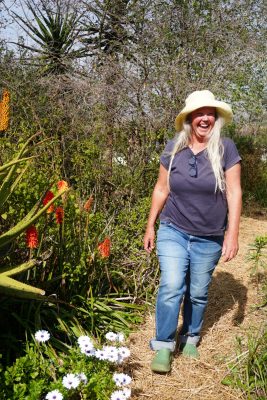
Jenny’s advice is simple: choose plants according to the conditions they naturally prefer, water them well while they establish themselves, and then allow them to settle into their environment.
As water becomes an increasingly precious resource, thoughtful plant selection is one of the most effective ways a gardener can create a beautiful outdoor space without creating unnecessary demands on water.
If your goal is to attract birds and butterflies throughout the year, Jenny recommends thinking about the garden as an ecosystem rather than simply filling beds with plants you happen to love.
Plant a diverse combination of trees, shrubs and groundcovers rather than creating large, sweeping beds of a single species, because wildlife needs food and shelter at different times of the year.
“You don’t want a ‘feast or famine’ situation, where one month you have aloes for sunbirds and then nothing for the rest of the year,” Jenny explains.
A varied planting scheme creates a continuous supply of food, shelter and habitat, while also giving the garden greater visual interest throughout the seasons.
And if you’re unsure where to begin, Jenny believes that seeking advice from someone with a deep knowledge of indigenous plants can make all the difference. There is an extraordinary range of indigenous plants available today, as well as an increasing number of indigenous open gardens offering inspiration.
Perhaps the most compelling thing about Jenny’s approach is that wildlife-friendly gardening doesn’t require us to sacrifice beauty. Quite the opposite.
A garden filled with indigenous plants can be lush, colourful and inviting. It can become a place where birds arrive at the patio, butterflies move between flowers and the sounds of wildlife become part of everyday life.
And it can become a sanctuary not only for us, but for the creatures that increasingly need somewhere to live and feed.
Jenny shares her knowledge through her landscaping work, garden mentoring and her specialist indigenous plant nursery in Summerveld. Her “nursery-in-a-garden” is open to the public on Fridays and Saturdays, offering gardeners the opportunity to explore the plants, enjoy the surrounding views and birds and get advice tailored to their own gardens.
Her philosophy is a hopeful one. “We don’t need to restore an entire landscape to make a difference. Sometimes, we can start with a tree, a shrub, a patch of groundcover, a birdbath or a little less insecticide. A garden planted with thought and intention can become more than a beautiful space. It can become a small but meaningful piece of habitat, alive with birds, insects, butterflies and the countless other creatures that make our natural world so wonderfully rich.”
And perhaps, in creating that little sanctuary for them, we create one for ourselves too.
Details: You can email Jenny at jenny@jennydeanwildflowers.co.za or follow her on Instagram: @jennydeanlandscaping or Facebook: Jenny Dean Wildflowers
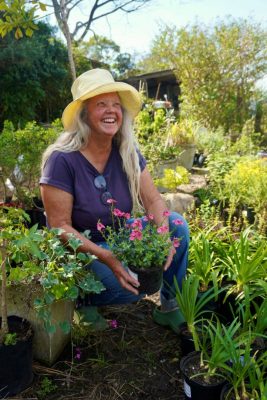
JENNY’S GARDEN WISDOM
Look at your garden as an ecosystem
Rather than choosing plants individually, think about how they work together. A successful wildlife garden offers different forms of food, shelter and habitat, helping support a greater variety of life.
Consider what happens after flowering
A plant’s contribution doesn’t necessarily end when its flowers fade. Jenny’s examples show how leaves can become food for caterpillars and fruits can provide nourishment for birds.
Give wildlife somewhere to gather
You don’t need a huge garden or elaborate landscaping to create a wildlife-friendly space. A strategically placed tree, shrub, groundcover or birdbath can become a small but valuable piece of habitat.
Allow the garden to evolve
A balanced garden is not something that has to be perfected overnight. Choose plants suited to your conditions, give them the care they need while establishing and allow the garden to develop over time.
Look for inspiration before you dig
If you’re unsure which indigenous plants will work in your garden, seek advice from someone with specialist knowledge. Visiting indigenous open gardens can also help you see just how varied and beautiful a local planting palette can be.
Jenny’s starting point
Ask yourself three questions before choosing a plant: What conditions does it naturally prefer? What could it provide for wildlife? And will it contribute something at a different time of year from the plants already growing in your garden?
This simple approach can help turn a collection of individual plants into a more connected, living garden.