
Phumelele Tau’s innovative co-working space, Mama Haus, might be the solution to work/life integration we’ve all been searching for.
Babies and boardrooms – not exactly a match made in heaven. But here’s a thought. Since so many of us in the working world have children, why do we try to pretend that we don’t?
It’s a question that has long tugged at Phumelele Tau, founder of Mama Haus. “Yes, we all want to be professional. But why does that mean acting as though our kids are a dirty secret? The reality is that many of us struggle with deadlines because we have family responsibilities … that a bad night’s sleep makes it hard for us to show up at our best in the office, or that we sometimes can’t keep our two lives separate.”
This notion was ticking away at the back of her mind around the birth of her son, who is now two. Like many mothers, she fell into depression after his birth, worsened by the slow decline of the production business she had successfully run with her brother since the two had left university. Television was something of a family business, as both parents had been in the industry, and as a writer and actor, the transition was natural for her. However, the company struggled to repeat its early successes – including producing a series for SABC1 and a movie for Netflix – once South Africa’s streaming industry started to evolve.
With fewer platforms available for pitching, the business started taking strain – and so did Phumelele. “It’s a creative industry, and I just couldn’t be creative.”
One of the obstacles hindering her was the fact that, although she needed to work, she didn’t want to take time away from her children. That’s when it hit her. Imagine if there was a space that allowed her to do both. Perusing the net to find a co-working space where working women could be moms, too, revealed that no such facility exists in South Africa – but Phumelele’s research showed that she wasn’t the only mother who would support the concept. “I ran an Instagram campaign to gauge demand, and found there were more than 60 women eager to sign up.”
Thus began the search for a suitable space. That wasn’t easy. Phumelele was against the idea of setting up in a standalone house (“because then you may as well work from home”), but commercial buildings were wary of letting children on site. She also wanted to make sure that the right facilities were available, like a garden where the babies could soak up the sun while climbing and exploring the outdoors.
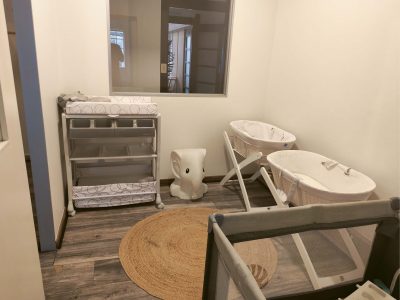
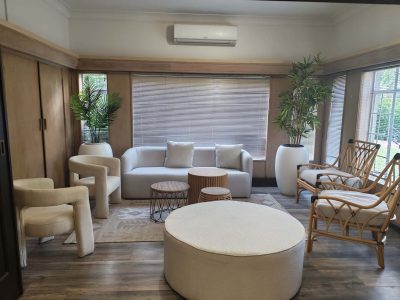
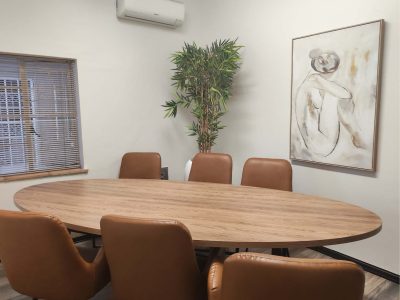
She found the perfect premises in Melrose Estate. To her delight, the building’s design allowed her to establish a number of spaces … there’s a communal workspace (where the children are welcome to wander in, get a cuddle and go), an area for quiet, focused work, a boardroom for formal meetings and even a breastfeeding room. Meanwhile, the children (aged from birth to three) are looked after by passionate childminders who have training in ECD, CPR and first aid.
Phumelele is pleased that the women who have signed up to work in the space have, quickly and organically, formed a community. “We show each other tremendous grace and are quick to offer support. That’s exactly what mothers need,” she maintains. “I never set up for this to become a power networking space.
Although I think it’s important for us to have a place where we can be adults, surrounded by other adults who know exactly what we are going through, I also love the fact that you can attend one of our events with your son sitting on your lap. You can come to work after rolling out of bed without having to apologise that you don’t look your best. And no one is trying to outdo each other. Instead of bragging about whose food is the ‘most’ organic, we empathise with each other about how hard motherhood can be sometimes – all while chasing deadlines, of course!”
Interestingly, many of the women who share the space are entrepreneurs, just like Phumelele. This speaks to a common theme. Some businesses owners are trying to get their startups off the ground just so that they can afford a nanny – and until they do, working on the business is a real challenge. “I was surprised to learn that the greatest need is amongst the middle class, for whom it’s sometimes a struggle to afford childcare,” Phumelele says. She’s concerned about the impact this has on women’s aspirations … how many businesses have died before they had a chance to grow, simply because women weren’t able to manage the juggle?
Not that there isn’t a need for a space like this in the corporate world. Phumelele points out that the return to work after maternity leave can be very difficult, and a space like this can ease the transition greatly. She’s currently in talks with several organisations to offer access to Mama Haus as a wellness benefit for new mothers, and sees potential for incorporating similar facilities on site.
Other future plans include opening branches in other areas. With mothers driving from as far afield as Broadacres and Centurion just so that they can have a hot cuppa and a moment’s peace while knowing their baby is well taken care of, it’s clear that demand is strong. But, as Phumelele says, “This isn’t a crèche, and it isn’t a working space. It’s a place where you can be yourself, without judgement, where everyone around you gets it” – or, as the sign above the Mama Haus door says, Mama, you’re welcome here. Details: Mamahaus.net, @mamahaus