What started as a job to make ends meet has lead Hillcrest barista Musa Mosikili all the way to the international stage. The 2026 South African National Barista Champion shares how far a cup of java can take you.
There are people who drink coffee, and then there are people who really see coffee, and Musa Mosikili belongs firmly in the second camp. For him, a cup is never simply a cup. Behind it are farmers and communities, geography and science, roasting and flavour, technique and creativity. And, perhaps most importantly, there is a person standing on the other side of the counter.
Just three years ago, financial difficulties forced Musa to put his university plans on hold, and he joined Starbucks in Hillcrest. Today, he is the 2026 South African National Barista Champion, with the opportunity to represent South Africa on the international stage at the EMEA Championship in London.
“I imagined a very different future for myself,” he says. “Initially, I saw it as a job and a way forward. I had no idea that walking through those doors would introduce me to coffee, incredible people and eventually a completely different purpose.”
That unexpected path has taught him something he now considers essential: Courage. Sometimes, he says, you have to be brave enough to accept that the path you planned isn’t necessarily the path that will reveal your purpose.
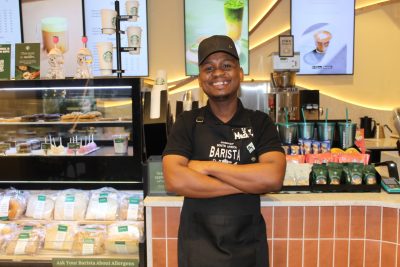 When Musa started out as a barista, he didn’t know coffee the way he does today. He was also still finding his confidence, particularly when it came to expressing himself in English.
Coffee gave him plenty of reasons to talk. Every day behind the bar meant meeting different personalities, asking questions, listening, explaining coffee and sometimes recognising that someone simply needed a little kindness.
“Initially that was intimidating,” he admits. “But every interaction built my confidence.” He learned that remembering someone’s name, knowing their usual order or asking about their day could make a genuine difference.
Guests started remembering him too, returning not simply for coffee, but for the connection. Some regulars have even started bringing their families into the store to meet him.
“When someone walks through the door and you remember them, you’re quietly saying, ‘I noticed you. You belong here.” That sense of belonging is central to how Musa sees his craft. “It’s a combination of craft and connection,” he says of being an exceptional barista.
Yes, the espresso needs to be right. The milk, temperature, balance and presentation matter. But then there is the person standing in front of you. “You can make the technically perfect cappuccino, but if that person doesn’t feel welcome, something is missing.”
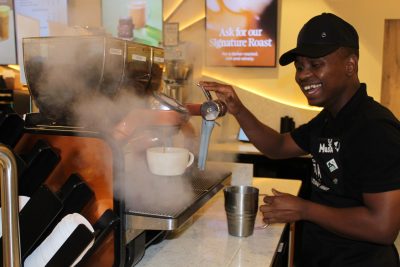 It is also why he refuses to judge people by what they order. “We definitely notice them!” he laughs when asked whether baristas secretly judge unusual coffee orders. “But we shouldn’t judge.” His philosophy is simple: If someone’s very specific coffee makes them happy, his job is to make their day, not question their choices.
Musa’s fascination with coffee grew as he learned more about what happens before the drink reaches the customer.
“Inside one cup are agriculture, geography, science, roasting and craftsmanship. The beans have travelled from a farm through processing, transportation and roasting before reaching the barista. Then the craft begins again. Grind size, water, temperature, extraction, milk texture and technique all influence what eventually reaches the customer. Once you understand the journey, you don’t just drink coffee anymore. You appreciate it.”
He has learned to taste with intention, considering acidity, body, sweetness and flavour rather than simply deciding whether something tastes good. And becoming a national champion hasn’t convinced him that he has mastered coffee. “For me, craft means never believing you’ve finished learning.”
Musa’s winning Caramel Comfort Cold Brew is perhaps the clearest expression of how he sees coffee.
Inspired by his mother, its bold coffee base represents her strength, while the balance reflects the stability she has brought to his life. The sweet, velvety oat milk cold foam represents her gentler side – her warmth and care.
“The drink is a picture of my mother in a cup,” he says. Creating it required him to share something personal. “When I had the opportunity to create something representing who I am and where I come from, it felt natural to tell her story.”
It is at this point that craft becomes storytelling for Musa. “You stop thinking about ingredients first and start thinking about emotions.”
Musa may be the one representing South Africa internationally, but he is clear that he didn’t get there alone. He talks about his ‘village’, the mentors, coaches, fellow baristas, guests and family members who encouraged him along the way.
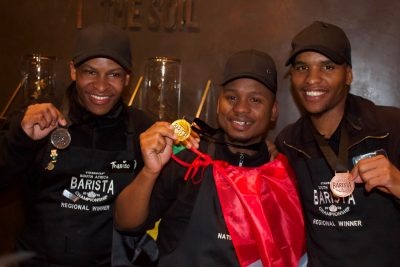 Among them are fellow South African EMEA title winners Teddy Nzama and Phuti Mmotla, last year’s SA champion Kabelo Jori and coach Ishan Natalie, affectionately known as Mr Miyagi. They believed in him before he had completely learned to believe in himself.
“I found people who encouraged me, developed me and gave me space to grow. Eventually I started believing in myself too.” That is why he sees his achievement as bigger than an individual result. “It belongs to my village.”
It is a sentiment deeply connected to Ubuntu, something Musa hopes to carry with him when he represents South Africa.
“I am because we are.”
For Musa, the international championship is about more than a result. It is an opportunity to meet champions from across the region, experience different coffee cultures and learn from some of the best baristas in the business.
Naturally, he wants to win. “Results matter. I’ve worked hard and I’m going there to compete.”
But he also understands that nerves are part of stepping into unfamiliar territory. “I think nerves mean something matters to you.” His solution is not to try to become somebody else. “I don’t need to become someone else in London. I just need the courage to be Musa.”
Whatever the final result, he hopes to return with new knowledge to share with other South African baristas.
“Everybody will arrive with different techniques, cultures, experiences and ways of thinking about coffee. Competition matters and I want a great result, but learning is bigger. I want to come home better than I left.”
And perhaps that is the real story behind the championship. Musa’s journey isn’t simply about how far one person can go. It is about what can happen when someone is given an opportunity, finds a community that believes in him and eventually finds the courage to believe in himself.
His advice to anyone wondering whether they are capable of more is wonderfully simple.
“Why not? Why not you? Why not now?”
It is a good question to ask over a cup of coffee. And perhaps an even better one to take with you when you leave the café.