
Winter is the time for succulent ‘roses’ like Aeoniums to show off. Great for pots and outdoor planters.
In winter, succulents can take us by surprise with their intense colours. Surprising, because they are so associated with summer as the go-to waterwise plants.
But all is not what it seems. One of the most beautiful succulents is the Aeonium, a winter growing variety that has spoon-shaped leaves which form large, beautiful rosettes in a variety of colours.
Unlike other succulents it is dormant in summer. It also needs more regular watering, because of its shallow roots which should not dry out completely. In winter plants need a warm, sheltered position, indoors or on a patio that receives at least six hours of sun a day to bring out their colours.
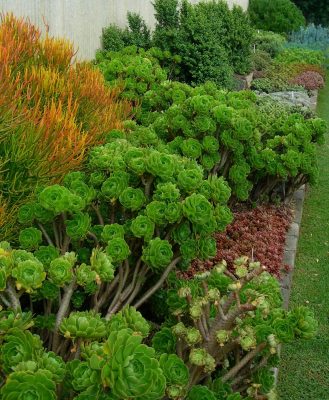
Aeoniums are dramatic plants that are available in many sizes and types. Some are compact, others are shrubby and the tallest are tree-like, hence the common name of Houseleek tree.
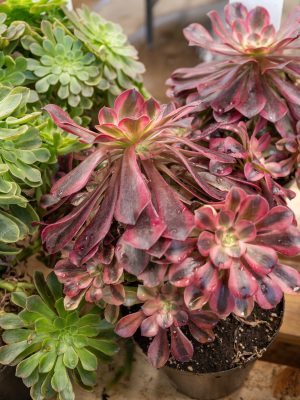
The Aeonium ‘Wheels’ series gets its name from the rosette that is arranged in perfectly layered circles which gives the plant its dramatic ‘wheel’ appearance. The elegant symmetry of its leaves makes it an ideal display plant on a bright windowsill or patio.
‘Wheels of Adoration’ and ‘Wheels of Fascination’ have variegated multicoloured rosettes in shades of deep pink, burgundy ‘and yellowish green, while ‘Wheels of Imagination’ and ‘Wheels of ‘Greenification‘ are predominantly green or with lashings of chocolate.
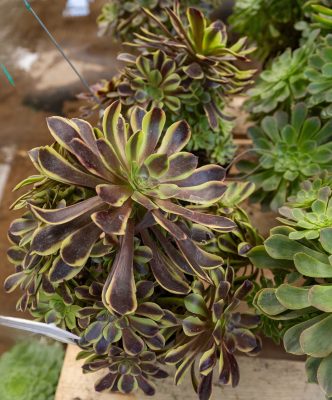
.The upright rosettes are carried on woody stems. They do best with bright light to gentle direct sun, for good leaf colour and compact growth. Water when the top layer of soil dries. They need slightly more frequent watering during their active growth phase.
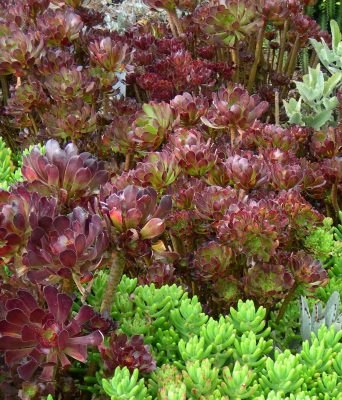
Aeoniums make the most impact when planted in mass. Use the wine-red varieties for contrast, and those with variegated rosettes to stand out. Plants with deep green rosettes offset fiery colours like those of Euphorbia “firesticks’ and they are generally used together with agaves, aloes, crassula and even low water use annuals and perennials.
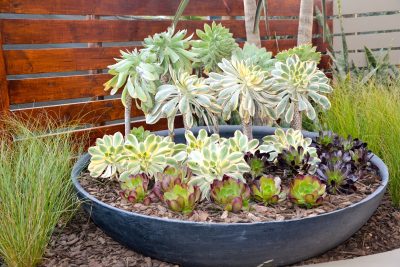
Aeoniums grow well in shallow containers and can be grown indoors or on a sunny windowsill or patio.
Planting tips
In the garden: Plant in composted soil for good drainage because root rot is a problem if the soil does not drain well or if they over watered.
Dig a hole that is just the size of the root ball and drop in the plant. But don’t fill in the soil around it. Leaving a gap around the plant allows the soil to work its way back in and around the roots. New roots will form near the soil surface where they can breathe.
In pots: It is not necessary to leave a gap as long as the potting soil drains well and the plant is not planted too deeply. After potting, wait two or three days before watering. This gives the roots time to recover and soak up the water. Plants in containers should be watered more often than those in the ground.
What if… Aeoniums can get leggy, but all you need to do is cut off the rosettes, leaving a few centimeters of stem and replant the rosette as a cutting. Just push it into the soil so that the bottom leaves are just above the soil. This is best done in autumn or early winter. The old growth can be put on the compost heap.
Did you know: Should plants be infested with scale or spider mites smother the pests by spraying with Neem oil. Soapy sprays are not recommended as they can damage the skin of the plant.
Content by www.ballstraathof.co.za
Article and images by Alice Coetzee.