
Roses have a timeless, romantic beauty that appeals to all generations. Even Gen Z gardeners who are increasingly embracing roses.
Gardeners who love roses typically put a lot of thought into the colour scheme, height and grouping of their roses. But what gives a bed of roses its finishing touch?
A decorative element in the form of a statue can add that final 10 percent. Statues provide a structured, architectural focal point that contrasts beautifully with every type of rose, from old fashioned and classical hybrid teas to free flowering shrub roses and cascading climbers.
However, there is an art to placing statues in the garden. Less is more. Rather one beautifully placed piece than a cluttered garden. Scale is important too, because a statue that is not in proportion with the garden can stand out like a sore thumb.
The starting point is to use a style of statue that harmonises with the style of the garden.
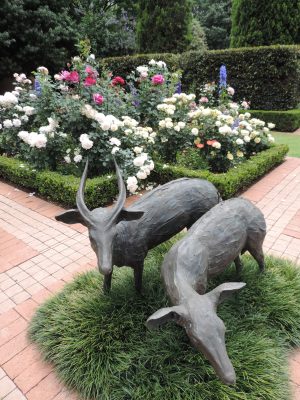
A formal garden is by nature symmetrical with well-defined lines. Decoration, such as statues, paving and edgings, gives the garden its formal character. Classical or romantic figures seem to work the best. These can be mythical figures or even animal sculptures.
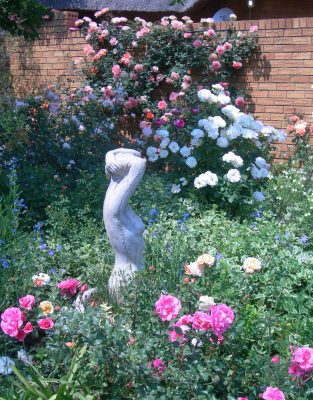
Not all rose gardens are formal. In natural or informal rose gardens, where roses mix happily with other plants a statue can still be very effective as a focal point that brings cohesion to an informal planting. There’s scope for statues that are more modern or abstract . It’s the ideal garden for Gen Z gardeners opting for low maintenance, disease resistant rose varieties that are pollinator friendly.
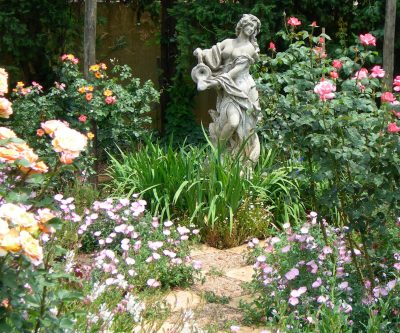
The most effective way to use a statue with roses is to carefully place it as a focal point, which draws the eye to a rose bed or acts as a focus within a bed of roses. When placing garden art as a focal point the aim should be to create a journey through the garden.
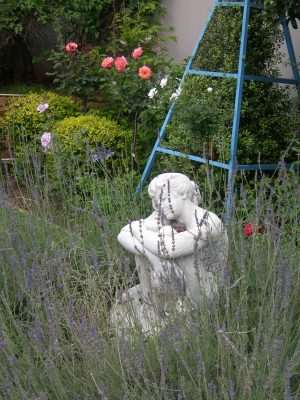
Statues can also be used playfully to intrigue or catch your attention, to create the unexpected, to act as a punctuation mark, or just draw the eye towards one area and away from another. It is a very effective way of turning a featureless corner into something visually attractive.
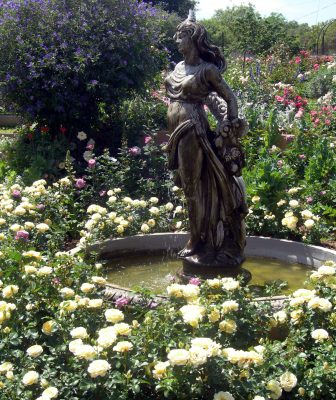
Scale is most important because sculpture must fit the scale of the garden. Advice from landscapers is that the one should consider the whole space of the garden when choosing a sculpture. For instance, in a small garden opt for smaller statues like cherubs or whimsical figures. In larger gardens, statues need to be bold and large enough not to be overlooked.
Content by: www.ludwigsroses.co.za
Article and images by Alice Coetzee.